AeroMaze UAV Swarm

Autonomous indoor exploration and traversal室内自主探索与集群穿屋

Liu Xu · Simulation lead; localization debugging and hardware integration in real flight刘旭 · 仿真阶段负责人;实机阶段定位联调与硬件集成

2025.07 — 2026.05 · Team project团队项目

Drag right to reveal the real robot向右拖动,查看实机

Simulation仿真
Real robot实机

Ten-UAV simulation and a separate external-camera real flight recording. The real source is labelled 2× speed; no additional speed change is applied. These runs are not time-aligned.十机仿真与独立机外实机飞行记录。实机原片标注 2 倍速,未额外加速;两段运行不作时间对齐。

Simulation and real-flight recordings仿真与实机记录

VR1 simulation recordsVR1 仿真记录

Both videos are from slide 6 of the November 2025 VR1 team presentation. They show distinct runs, separate from the ten consecutive tests below and the final acceptance result.两段来自 2025 年 11 月 VR1 团队汇报第 6 页,展示两次独立运行;与下文的连续十次测试及后续验收分别呈现。

Planning and interfaces规划与接口

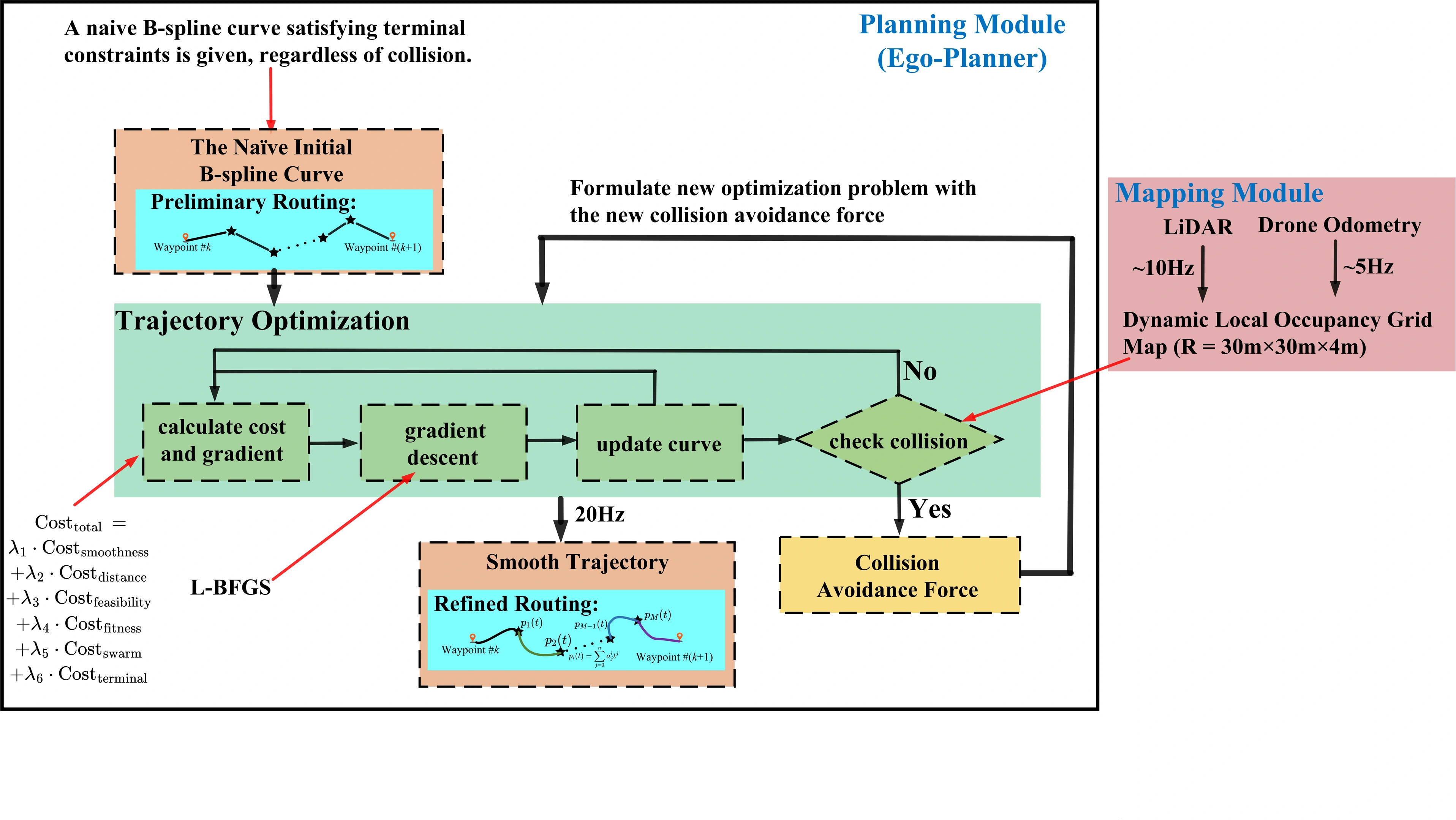
The ten-UAV simulation uses ROS2 and Unity HiFi Simulator. I adapted EGO-Planner local planning, collision avoidance and replanning for indoor traversal, including safety margins, velocity limits, takeoff order and mission flow. ROS2 topics and services connect mission initialization, odometry, cameras, trajectories and completion results.十机仿真基于 ROS2 与 Unity HiFi Simulator。我负责 EGO-Planner 局部规划、避障与重规划适配,调整安全距离、速度限制、起飞顺序和任务流程;通过 ROS2 Topic/Service 接入任务初始化、里程计、相机、轨迹和任务结果。

The November 2025 VR1 team presentation describes adaptive planning horizons at narrow openings, speed adjustment by distance to the next waypoint to reduce team gaps, and a drone-centred dynamic grid map to limit memory use. These are system-design choices reported in that phase; later final acceptance is reported separately.2025 年 11 月的 VR1 团队汇报记录了三个系统设计:在窄门处动态调整规划视距;按到下一航点的距离分配速度,减小队伍间隔;使用以无人机为中心的动态栅格地图控制内存开销。这些是该阶段的系统设计,后续验收结果单独报告。
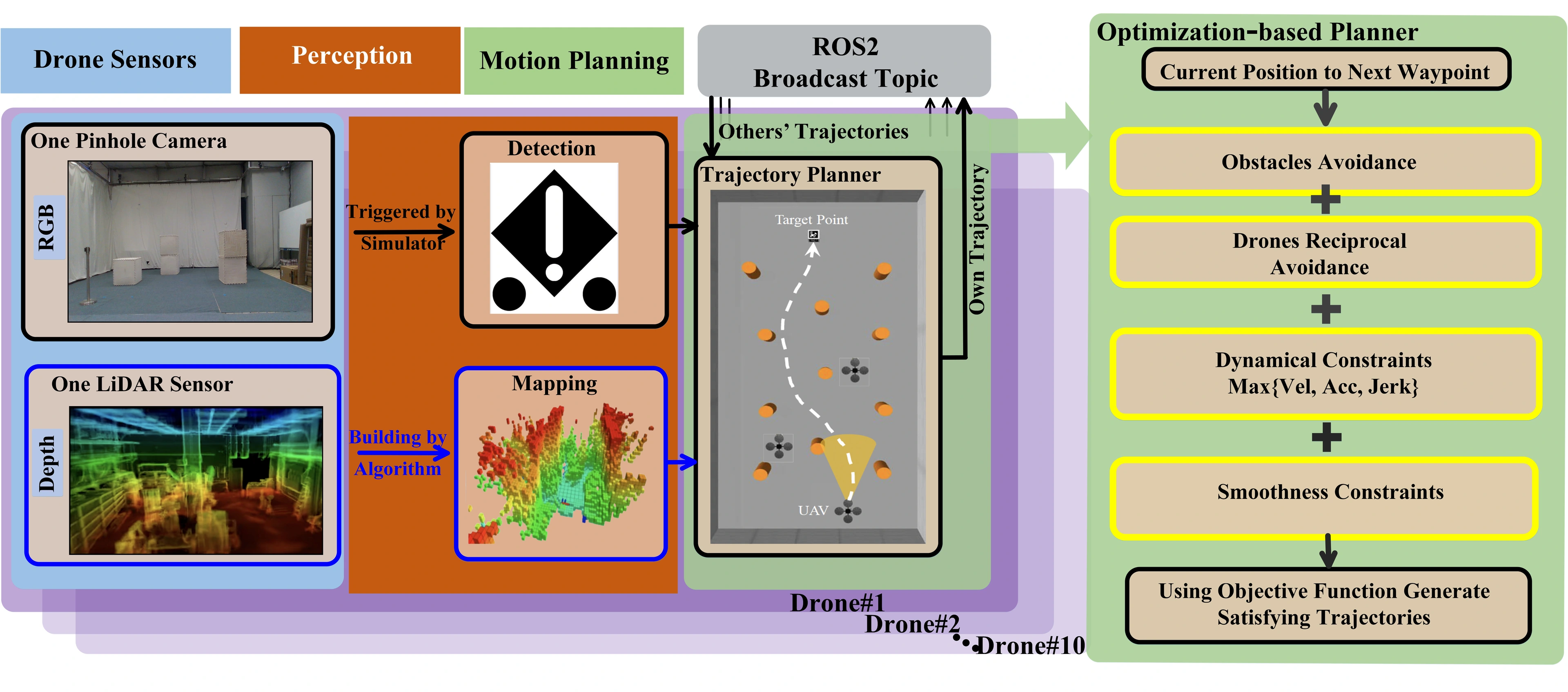
系统架构 · VR1 团队汇报第 2 页原图
System architecture · original figure, VR1 team presentation, slide 2系统架构 · VR1 团队汇报第 2 页原图
规划方法 · VR1 团队汇报第 3 页原图
Planning formulation · original figure, VR1 team presentation, slide 3规划方法 · VR1 团队汇报第 3 页原图

Localization and onboard integration定位与机载集成

For the three-UAV deployment on ROS1 and Ubuntu 20.04, I contributed to LIO/FAST-LIO scan-to-map matching, initial-pose alignment and odometry fault investigation. I also contributed to Manhattan-world/IMU-gravity initial scan alignment and official-frame relocalization, and to increasing LIO updates from 10 Hz to 100 Hz.三机实机阶段使用 ROS1/Ubuntu 20.04。我负责部分 LIO/FAST-LIO 的 scan-to-map 匹配、初始位姿对齐与 odom 异常排查,参与基于 Manhattan 世界特征与 IMU 重力估计的初始扫描对齐、官方坐标系重定位,以及将 LIO 更新频率由 10 Hz 提升至 100 Hz 的联调。

Hardware work covered part of the selection, mounting, wiring, power connections, interface configuration and troubleshooting of Livox Mid-360, monocular cameras, Jetson Orin NX, flight controllers and airframes. Team module tests report localization and 3 m/s trajectory-tracking errors below 10 cm, and single-UAV traversal through a 60 cm opening at 3 m/s.硬件工作包括 Livox Mid-360、单目相机、Jetson Orin NX、飞控和机架的部分选型、安装固定、接线供电、接口配置与故障排查。团队模块测试中,定位及 3 m/s 动态跟踪误差均小于 10 cm,并支持单机以 3 m/s 通过 60 cm 窄门。

Planning and mapping runtime规划与建图耗时

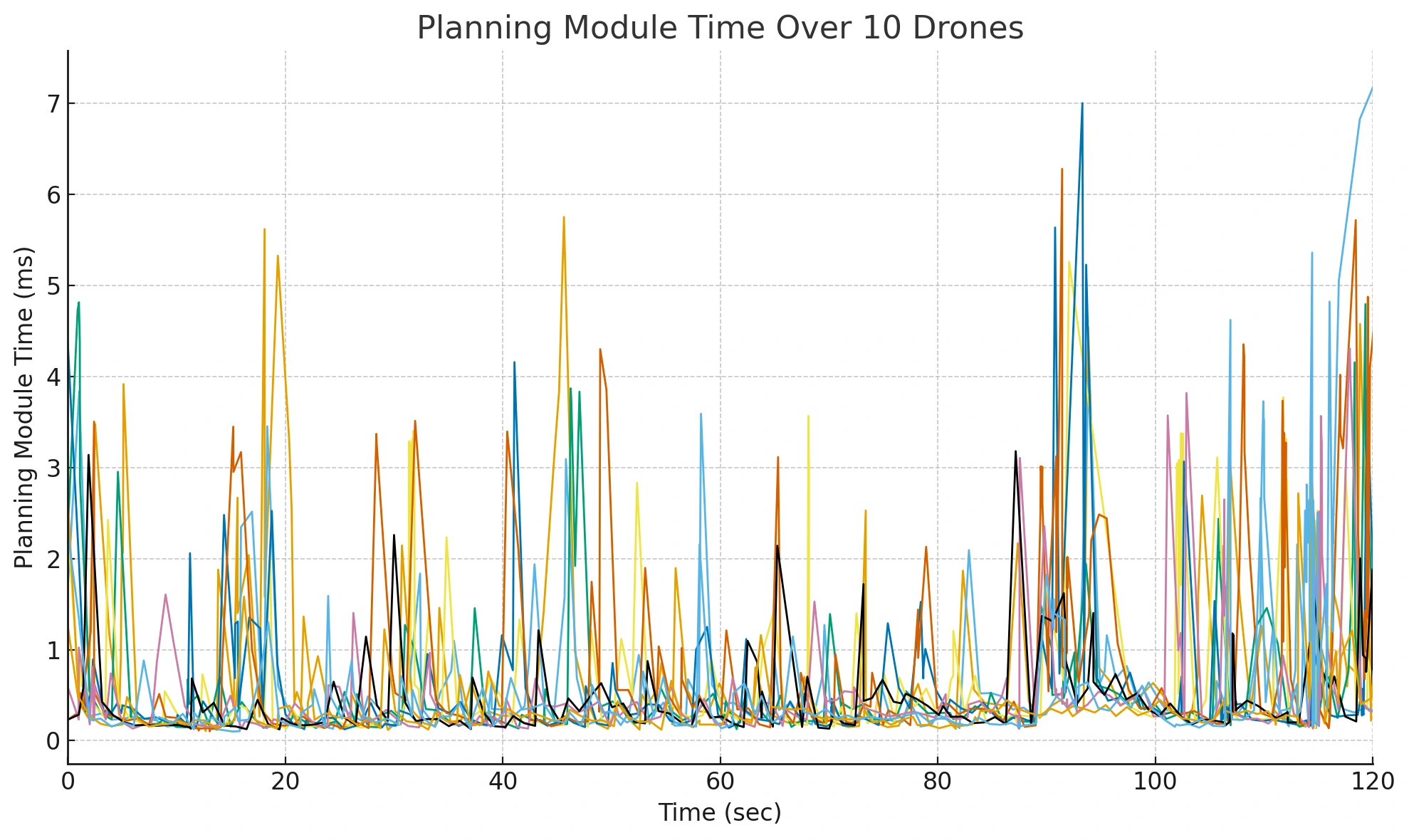
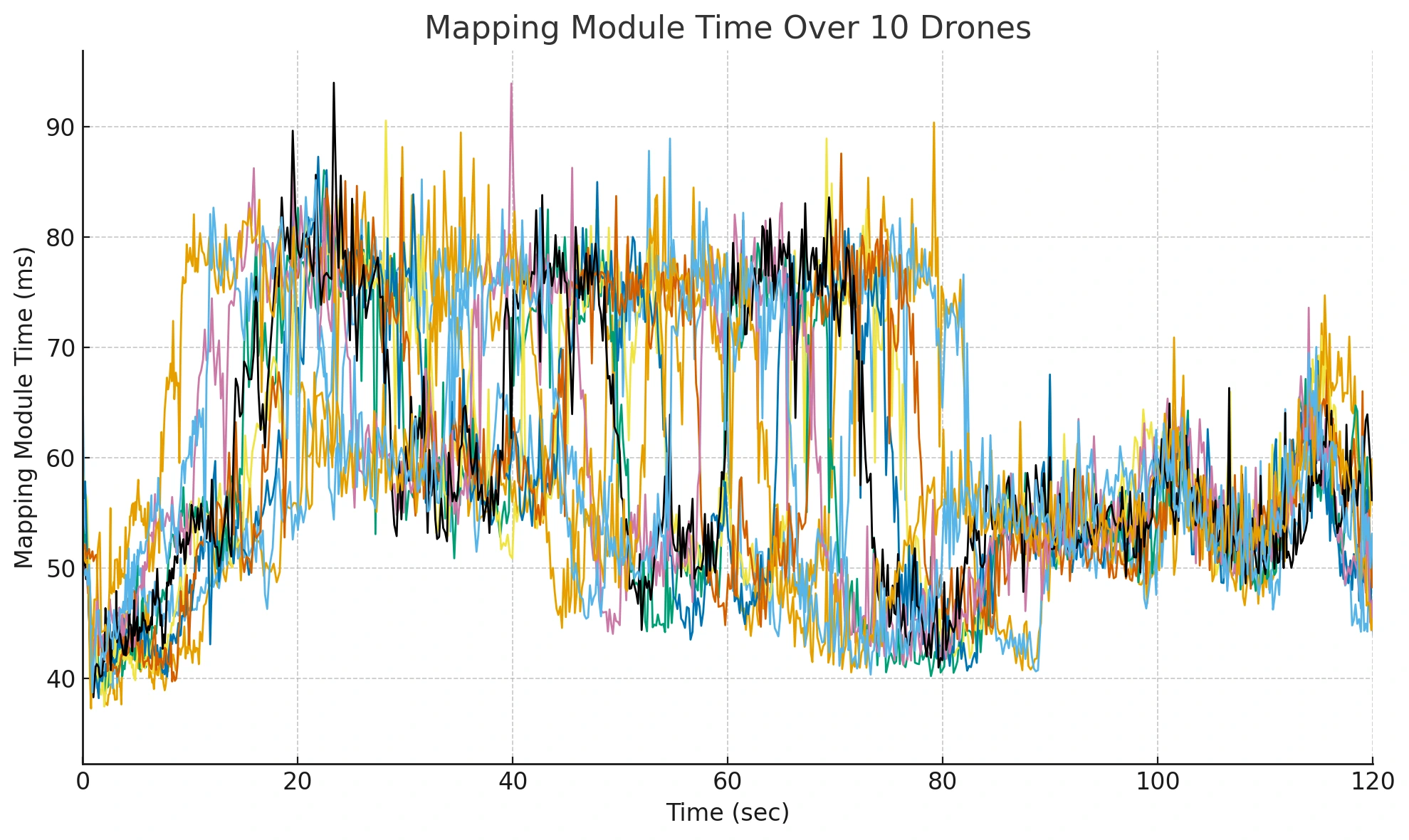
VR1 records the planning and mapping runtime of ten drones over roughly 120 s. The original plots report milliseconds; no mean, percentile or processor specification is supplied. These are module runtimes, separate from trajectory-update frequency and later real-platform LIO frequency.VR1 材料记录了十架无人机约 120 s 内的规划与建图耗时。原图单位为毫秒,未提供均值、分位数或处理器规格。这是模块耗时,与轨迹更新频率、后续实机 LIO 频率分别报告。

规划模块计算时间 · VR1 第 4 页原图;纵轴为毫秒,横轴为秒。
Planning runtime · VR1 slide 4; vertical axis: milliseconds, horizontal axis: seconds.规划模块计算时间 · VR1 第 4 页原图;纵轴为毫秒,横轴为秒。
建图模块计算时间 · VR1 第 4 页原图;纵轴为毫秒,横轴为秒。
Mapping runtime · VR1 slide 4; vertical axis: milliseconds, horizontal axis: seconds.建图模块计算时间 · VR1 第 4 页原图;纵轴为毫秒,横轴为秒。

Phase-specific test results分阶段测试结果

VR1 development tests · November 2025VR1 开发测试 · 2025 年 11 月

Ten consecutive Basic Sequence runs in the team presentation complete with all ten agents and no crashes. Recorded team times range from 122 to 135 s; six runs report collisions. These are development tests, distinct from the 166 s simulation acceptance result.团队汇报中的连续十次 Basic Sequence 测试均为十机完成、无坠机,用时 122–135 s;其中六次记录了碰撞。这是开发测试,与 166 s 的仿真验收成绩分别报告。

Original results from VR1 slide 5VR1 第 5 页原始结果
Run测试Team time (s)团队用时(s)Gap (s)间隔(s)Completed完成Collisions碰撞Crashes坠机
1127410/1020
2122110/1010
3135210/1020
4125210/1010
5127510/1000
6122310/1000
7125410/1000
8128410/1000
9128310/1010
10125210/1010

Final acceptance后续验收

Simulation: 10/10 completed, 166 s, first of eight teams by completion speed. Real flight: Basic Sequence / Alternate Sequence / Demo Day take 50 / 60 / 72 s respectively, with 100% success (3/3) in each. The real acceptance ranks second of eight teams by completion speed. These are team results; my individual responsibilities are stated above.仿真验收:10/10 架完成,166 s,完成速度排名 1/8。实机 Basic Sequence/Alternate Sequence/Demo Day 分别为 50/60/72 s,各项成功率均为 100%(3/3);实机验收完成速度排名 2/8。以上为团队成绩,我的个人分工见前文。

What transfers—and what changes从仿真迁移到实机时的变化

Sensor placement affects the planner, not only localization. VR1 reports that forward-tilted LiDAR captures more ground features but introduces a blind zone. Keeping the tilt consistent with the real platform required substantial planner retuning after obstacle-avoidance performance degraded in simulation.传感器安装不仅影响定位,也影响规划。VR1 记录了雷达前倾带来的地面特征覆盖收益与盲区:为了保持与实机一致的倾角,仿真避障表现下降后,需要重新调整规划参数。

The same presentation identifies two transfer gaps: simulated localization noise does not accumulate into drift, and simulated LiDAR does not observe moving drones. In real flight, drift correction and handling returns from other drones require separate attention. Drift correction and drone-return filtering were proposed as future live-run work at the VR1 stage.同一汇报明确了两个迁移缺口:仿真定位噪声不会累积为漂移,仿真雷达也不感知移动无人机。实飞需要另外处理漂移修正与其他无人机的点云回波。漂移修正与无人机回波过滤在 VR1 时属于后续实飞计划。

The simulation includes motion dynamics and random localization/control noise, but does not use HiFi's radio-communication model. The ten-UAV tests therefore do not establish robustness to bandwidth constraints or scaling to 60–100 vehicles. Those larger-team figures in the slides are future directions.仿真包含运动动力学及定位、控制随机噪声,但未使用 HiFi 的无线通信模型。因此,十机结果不能直接证明带宽受限条件下的鲁棒性,也不能作为 60–100 机扩展能力的验证;汇报中的更大集群规模属于后续方向。

Project record项目记录

System figures and development tests are from the November 7, 2025 VR1 team presentation. Individual responsibilities and later acceptance results are reported separately. The videos show separate runs and are not time-aligned. Web copies are encoded for browser playback; original timing is retained, and the ICL opening is removed from the onboard-camera test recording.系统图与开发测试来自 2025 年 11 月 7 日 VR1 团队汇报,个人分工及后续验收成绩分别列示。视频来自独立运行,不作时间对齐。网页版为浏览器播放编码,保持原始时序;机载相机测试记录已去除 ICL 片头。

Return to all projects返回全部项目